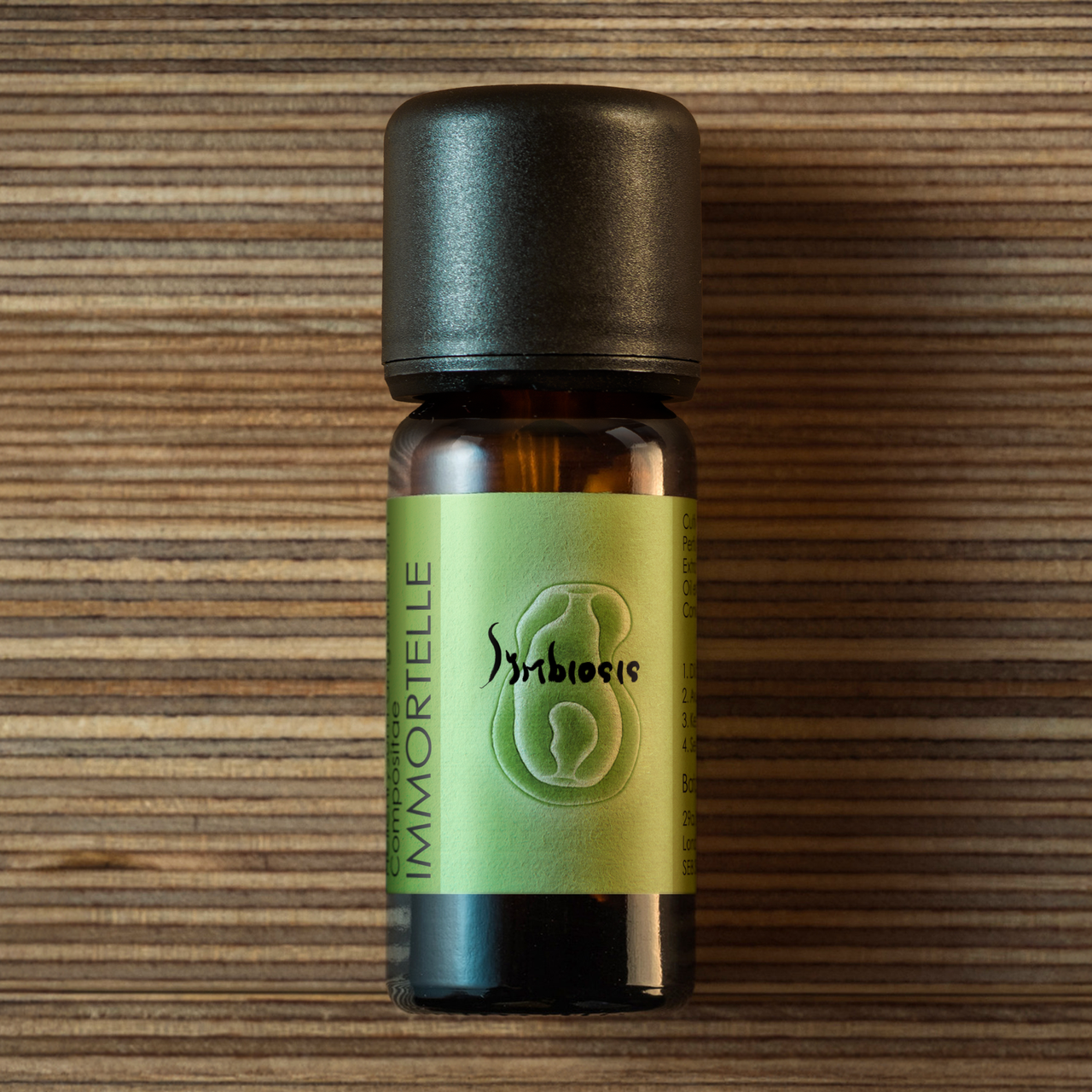
Pure Essential Oil
Immortelle
Helichrysum angustifolium
Herbaceous · Leafy kitchen and garden herbs. Aromatic and dry.
£38.50 5 ml
Sample page: the basket is not connected yet.
- Origin
- France
- Botanical family
- Asteraceae
- Extracted from
- Flowering tops
- Extraction method
- Steam distillation
- Note
- Middle/base
- Use
- Active or passive diffusers
- Strength
- Pure and undiluted. Read the precautions before any use on skin.
- Scent family
- Herbaceous, with Chamomile, Chamomile, Melissa, Marjoram, Basil
Every order comes with a bookmark card and one practice to try: one oil, one room, the same hour, for two weeks.
How it behaves in a room
Distinctive rather than loud; a dry, honeyed note with a curry-like edge that stays moderate in the air. Close-to-mid reach; a light top spreads while the heavier base keeps it near its source. Moderate; the bright top passes, then a quieter base holds a while underneath.
See how immortelle moves through a room, beside the other oils in the Scent Atlas
Aroma
Warm, honeyed, and surprisingly complex—like dried flowers steeped in honey and tea, with an herbal depth that's both sweet and slightly medicinal.
The opening is rich and almost maple-like, with a syrupy sweetness that's tempered by hay-like, earthy undertones. There's a subtle curry-like spiciness to it, hints of fenugreek or dried herbs warming in oil, which gives it an unusual savoury-sweet quality that some people find intriguing and others find off-putting.
As it develops, you notice floral notes that are dried rather than fresh—like flowers pressed in books for years, their scent concentrated and mellowed by time. There's a resinous, slightly smoky quality underneath, something tea-like and contemplative, with whispers of chamomile and tobacco leaf.
The scent has a golden weight to it, a richness that feels preserved and patient, like something that's been carefully stored and only improves with age. It doesn't announce itself brightly; it unfolds slowly, revealing layers the longer you sit with it.
Personality
Immortelle is the person who's lived through enough to have perspective, who doesn't react to drama because they've seen it all before and know it will pass. They're patient in a way that's rare—not because they're suppressing urgency, but because they genuinely understand that some things can't be rushed. There's a quiet resilience to them, the kind that comes from having survived difficult things without becoming brittle or bitter.
They're the friend who doesn't try to fix your problems but will sit with you through them, who reminds you that healing takes time, who knows the difference between numbing pain and actually addressing it.
Conversation with them moves at its own pace; they're comfortable with pauses, with letting things settle before responding. You leave their company feeling less rushed, more willing to let things unfold in their own time, like someone just reminded you that endurance is its own kind of strength.
Cross-sensory associations
Colour: Deep golden-amber like honey that's been aged, with hints of burnt orange and dusty yellow. The colour of late afternoon light through dried grasses, warm but not bright—mellowed by time.
Texture: The sticky richness of honey, the dry papery feel of everlasting flowers, warmth that penetrates slowly rather than hitting immediately. Dense, concentrated, patient.
Architecture & Interiors: Provençal stone farmhouses and Mediterranean hill town apothecaries (1600s-1800s)—spaces built to endure, where thick walls and small windows protect against extremes, where herbs dry slowly in dim rooms and preservation is a practised art. Think ancient stone mas in Provence, hilltop villages in Tuscany or Corsica, or medieval pharmacy interiors.
Architecture: Thick stone walls (sometimes three feet deep) that maintain temperature stability, small windows with deep reveals and wooden shutters, vaulted or beamed ceilings that trap cool air, stone or terracotta floors worn smooth by centuries of feet, walls rendered with lime plaster that breathes and ages rather than sealing.
Interiors: Bundles of dried immortelle hanging from rafters alongside lavender and thyme, ceramic jars containing oils and salves made from local plants, wooden tables darkened by age and use, minimal furniture because the space itself—its coolness, its stillness, its accumulated scent—is the primary feature.
Spaces where time moves differently because the architecture was built to last generations, where the smell of dried herbs has permeated stone so deeply it seems permanent, where healing happens through patient application of what grows locally rather than through intervention from elsewhere.
Sound: The rustle of dried flowers being handled carefully, glass jar lids being unscrewed and replaced, the scrape of a wooden spoon mixing salve in a ceramic bowl. Silence that feels full and golden, like late afternoon when even insects are quiet in the heat.
Self-Place Bond
Immortelle makes a space feel like it can hold time—not rushing recovery, not demanding progress, just steadily supporting the slow work of actual healing. It's the scent of a room where you tend to injuries that won't heal quickly, a bathroom where you apply treatments consistently over weeks rather than expecting overnight transformation, a corner where you acknowledge that some damage takes years to repair.
Some people use it when they're dealing with chronic conditions or old wounds—physical or emotional—that require patience and repeated attention, when the work is maintenance rather than cure. It supports endurance. It creates an atmosphere where slow progress is still progress, where showing up daily matters even when nothing seems to change, where the accumulation of small attentions over time is recognised as its own form of healing.
For those building a Restoration bond with their home, Immortelle creates the sense that this space understands deep time—that real healing doesn't happen on demand, that some things require months or years of consistent care, that patience itself is medicine.
For others, it supports Storage in an unexpected way: by helping you preserve not just objects but the resilience required to keep tending to what matters, to maintain practices even when results aren't visible, to trust that what you're doing will matter eventually even if you can't see it yet.
Blends well with
Lavender: Softens the rich sweetness with herbal calm, making the blend more about gentle rest than about patient endurance. The scent becomes lighter, more bedtime-appropriate. → Restoration
Frankincense: Adds resinous brightness that lifts the heavy honey into something more contemplative. The blend becomes more about sacred patience than simply waiting. → Restoration
Rose Otto: Deepens the floral quality into something more luxurious and intentional. The blend becomes about self-care as sustained practice rather than occasional indulgence. → Intimacy
Sandalwood: Grounds the sweet honey with creamy wood, adding depth and stillness. The blend becomes even more about patience, about sitting with what is rather than pushing towards what could be. → Restoration
Shelf life and precautions
Shelf life
Keep in a cool, dark place in a tightly sealed amber/black bottle. 2-3 years
Precautions
Dilute before topical use to prevent skin sensitivity; avoid if on blood-thinning medications. More Safety Information
The information provided on this website is for educational purposes only and may not be entirely accurate or complete. It is not intended to diagnose, treat, cure, or prevent any disease. Please note that the photos of the plants are intended to represent the typical appearance of each plant, but may vary based on location, growing conditions, and time of year. We recommend consulting with a healthcare professional before using any essential oils if you are pregnant or breastfeeding, or have any underlying health issues.
Other herbaceous oils