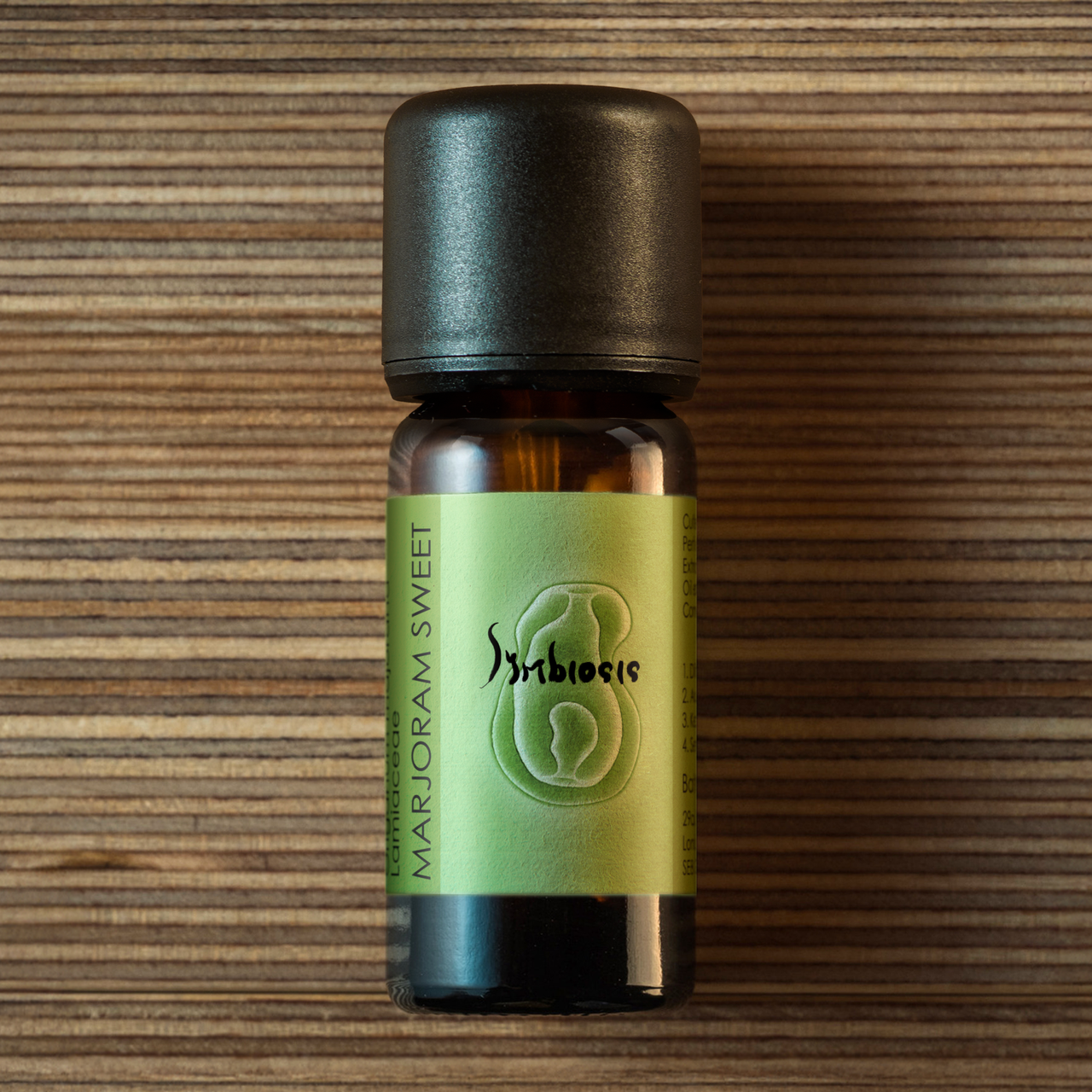
Pure Essential Oil
Marjoram sweet
Origanum majorana
Herbaceous · Leafy kitchen and garden herbs. Aromatic and dry.
£13.00 10 ml
Sample page: the basket is not connected yet.
- Origin
- Egypt
- Botanical family
- Lamiaceae
- Extracted from
- Leaves & flowers
- Extraction method
- Steam distillation
- Note
- Middle
- Use
- Active or passive diffusers
- Strength
- Pure and undiluted. Read the precautions before any use on skin.
- Scent family
- Herbaceous, with Chamomile, Chamomile, Immortelle, Melissa, Basil
Every order comes with a bookmark card and one practice to try: one oil, one room, the same hour, for two weeks.
How it behaves in a room
Medium soft; warm, herbaceous with a homely, kitchen-side quality. Close-range cocoon; fits best in intimate, quieter rooms. Moderate; settles into a background of gentle comfort.
See how marjoram moves through a room, beside the other oils in the Scent Atlas
Aroma
The opening is green and slightly camphoraceous, but the camphor is subdued here, present as warmth rather than sharpness, the terpinen-4-ol giving it a quality of herbal reliability without the medicinal edge that oregano or thyme carry at the same family register. A peppery warmth builds underneath, the sabinene bringing faint nutmeg and cardamom adjacency, something almost tea-like that keeps the scent in the domestic rather than the clinical. The dry-down is earthy and quiet, the herbaceous quality settling into something grounded and undemanding. Oregano shares the family but is sharper, more phenolic, more insistent; sweet marjoram holds back from all of that, the linalool softening the edges until the scent occupies the room the way warmth occupies a room rather than the way a specific smell does.
Personality
Marjoram Sweet is the person who shows up with soup without being asked and does not require acknowledgement for having done so. The care they offer is expressed through action rather than words, through the specific practical things that address what is actually needed: warmth, food, quiet, the sense that someone is attending without hovering. There is a maternal quality in it that has nothing to do with gender and everything to do with a reliable orientation towards the basic needs of whoever is in the room. Companionable silence is more their register than conversation; they are more comfortable ensuring you are warm and have eaten than discussing how you feel about being unwell. You leave their company feeling steadier, the specific steadiness of having been looked after in ways that did not require you to perform being fine.
Cross-sensory associations
Colour
The colour is soft grey-green with warm brown undertones, the colour of dried marjoram after a summer on the stem: dusty olive, pale khaki, the muted tones of herbs that have given up their brightness in the drying and kept only their warmth. There is no vivid saturation here; the palette belongs to things that have been useful for a long time and have the patina of that use. The camphoraceous opening registers as a briefly cooler grey before the warmth of the heart pulls the palette back towards olive and brown.
Texture
In the air it has the warmth of a hot water bottle felt through flannel: not the direct heat of something applied to skin but the gentler, more diffuse warmth of something that has been warming a space and continues to do so without announcement. The camphoraceous opening has a very slight roughness, the texture of a dried herb leaf rather than a fresh one, which smooths into something softer and more enveloping as the linalool heart takes over. The dry-down has the texture of old wool, washed many times, warm and slightly heavy.
Architecture
The plan is thick-walled and inward-facing: stone construction with small windows set into deep reveals, the apertures sized for insulation rather than view, the light inside always several degrees removed from the brightness outside. The ceiling is low, the beams exposed, the volume compressed enough to hold heat without the help of a large fire. An open hearth on one wall, the chimney breast taking up more of the room than seems proportionate, the fireplace the organising centre of the plan rather than a decorative feature. The body enters through a low door, feels the warmth change immediately, moves towards the hearth without deciding to. The floor is stone at ground level, worn smooth at the centre of the most-used path. Marjoram sweet runs as a quiet warm current through the lower volume of this room, the herbal band the plan holds between floor level and the height of the table, where the warmth from the hearth and the warmth from the scent are the same quality of air.
Interiors
Simple wooden furniture darkened by age and proximity to the hearth, the surfaces carrying the accumulated smoke and warmth of many winters. Wool blankets folded over the back of the chair nearest the fire, their weight visible in the way the fabric falls. Ceramic jars on the open shelf, their labels worn, the contents identifiable by smell rather than by reading. A kettle on a trivet, still warm. Bundles of dried herbs hanging from a beam hook, their stems bound with undyed twine. The hand reaches for the blanket, lifts it, settles it. The patina here is entirely of use and of the warmth that use generates: the chair worn at the arms where hands have rested, the floor darker at the hearthside where the fire has been tended for years. The scent gives the room its quality of quiet maintenance, the soft herbal warmth that rises from the dried bundles and the wool and the old wood together, making being in this room feel like being held rather than simply being inside.
Sound
Water poured from a kettle into a ceramic teapot, the sound of it filling the pot, the brief silence as the lid is placed. Then the creak of floorboards as someone moves in the room above. The acoustic is absorbed and soft, stone and wool and old timber catching the sound before it travels, the room keeping its sounds to itself. Where clove bud is the sound of a drawer defining a boundary, marjoram sweet is the kettle being lifted: domestic, warm, the sound of someone attending to a basic need without ceremony.
Self-Place Bond
Restoration
Marjoram sweet makes a room feel adequate to holding someone who is genuinely unwell rather than merely tired. The quiet warmth of the terpinen-4-ol, the quality of a scent that settles rather than announces, gives a bedroom or a sitting room used during illness a quality of serious tending: the space is organised around the basic requirements of recovery, warmth and quiet and rest, without requiring the person in it to perform improvement. This is the restoration of being looked after in simple, proven ways, not the restoration of addressing something difficult, as German chamomile enables, but the restoration of the body's most basic needs being met without fuss.
Intimacy
Marjoram sweet's Intimacy is the register of vulnerability permitted. In a bedroom or a bathroom used at the end of a long day, or during illness, or at any moment when strength has been required for longer than is sustainable, the scent makes the room feel safe enough to be depleted in. The warmth does not ask anything; it simply maintains the temperature of the space at the level where being honest about needing care does not feel like an imposition.
Blends well with
Lavender 50/52: Softens the camphoraceous opening into something quieter and more domestic, the linalyl acetate bridge carrying the blend towards a bedroom that takes rest seriously without the lavender's directness overwhelming the marjoram's gentleness. → Restoration
Chamomile Roman: Deepens the quiet warmth into something softer and more specifically restorative, the two oils meeting at their shared quality of uncomplicated, unhurried care. A bedroom during illness or at the end of a difficult week. → Restoration
Frankincense: Grounds the herbal warmth into something slower and more considered, the resinous dry quality of the frankincense giving the blend a structural depth that marjoram alone does not sustain. → Intimacy
Cedarwood: Warms the earthy dry-down into something with more horizontal weight, the cedar's creaminess meeting marjoram's terpinen-4-ol warmth to produce a blend that holds the room's temperature long after the initial top has cleared. → Restoration
Clary Sage: Deepens the herbal register into something warmer and more musky, the two oils sharing a quality of herbaceous comfort that the blend makes denser and more enveloping. An evening room where nothing is required. → Intimacy
Shelf life and precautions
Shelf life
Keep in a cool, dark place in a tightly sealed amber or black bottle. Best used within 2 to 3 years.
Precautions
Dilute before skin application; use at 2 percent maximum. Avoid during pregnancy and while breastfeeding due to potential emmenagogue effect. Generally well tolerated. Not for internal use.
The information provided on this website is for educational purposes only and may not be entirely accurate or complete. It is not intended to diagnose, treat, cure, or prevent any disease. Please note that the photos of the plants are intended to represent the typical appearance of each plant, but may vary based on location, growing conditions, and time of year. We recommend consulting with a healthcare professional before using any essential oils if you are pregnant or breastfeeding, or have any underlying health issues.
Other herbaceous oils